All truths are easy to understand once they are discovered; the point is to discover them.”
–Galileo Galilei
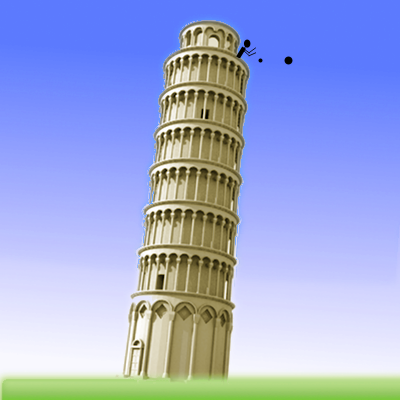
Do you remember the following equations of motion learnt in high school? These equations describe the motion of objects under constant acceleration:
$latex v = v_0 + at \qquad \qquad \qquad \boldsymbol{(1)} &fg=0A0A0A&s=3 $
$latex x – x_0 = v_0t + \frac{1}{2} at^2 \qquad \;\boldsymbol{(2)} &fg=0A0A0A&s=3 $
$latex v^2 = v_0^2 + 2as \qquad \qquad \;\;\;\boldsymbol{(3)} &fg=0A0A0A&s=3 $
Take the second equation. Here v0 refers to the initial velocity. When we drop an object from some height above the ground, the initial velocity is zero. And (x – x0 ) refers to the distance travelled by the object, which is height, say ‘s’ . So, the equation can be written as:
$latex s = \frac{1}{2} at^2 &fg=0A0A0A &s=3 $
For a freely falling object the acceleration ‘a’ is ‘g’ ( the acceleration due to gravity). Replacing ‘a’ with ‘g’ and rearranging the factors in the above equation, we get this:
$latex t = \sqrt{\frac{2s}{g}} &bg=ffcccc&fg=cc00ff&s=4 $