The Coriolis Effect
Understanding Its Nature
And Implications
Introduction
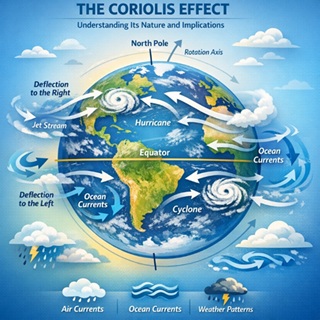
The Coriolis effect is a phenomenon caused by the rotation of the Earth, resulting in the apparent deflection of moving objects—such as air currents, ocean currents, missiles, and even airplanes—relative to the surface of the planet.
While objects move in straight paths relative to space, observers on Earth perceive their paths as curved due to Earth‘s rotation beneath them. This effect is named after the French mathematician Gaspard-Gustave de Coriolis, who described it mathematically in 1835.
In this article, we will explore the science behind the Coriolis effect, why it occurs, how we can observe it, and where it manifests in nature.
Why Does it Occur?
The Coriolis effect arises because the Earth is a rotating sphere. As the planet spins on its axis from west to east, different points on its surface move at different velocities. Objects moving across the surface are subject to a deflection due to this rotation. Specifically, the Coriolis effect causes moving objects to shift to the right in the Northern Hemisphere and to the left in the Southern Hemisphere.
This deflection is not due to any physical force pushing the object sideways; instead, it is a result of moving in a rotating reference frame. For example, when air moves north or south, it retains the eastward velocity it had at its original latitude. As it moves, the difference in rotational speed across latitudes causes the apparent shift in direction.
Illustration of Coriolis Effect
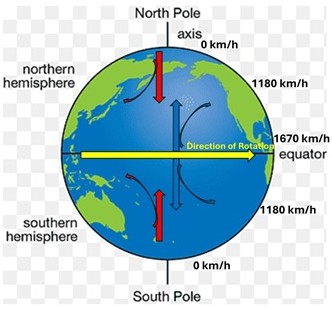
Consider the blue arrow representing wind or projectiles moving in the northern hemisphere from the equator towards the north pole. As it moves north from the equator it continues to keep the eastern velocity which is maximum (1670 km/h) at the equator. However, the points in the northern latitudes move with lesser and lesser velocity. So, the net result is the apparent deflection of the projectile to the right.
For the same reasons, the projectile moving towards the south pole from the equator gets deflected in the left direction.
This deflection is not due to any physical force pushing the object sideways; instead, it is a result of moving in a rotating reference frame. In other words, the deflection is apparent to the folks on the surface of the earth. If someone watches the movement of these projectiles from space, they appear to move in a straight line.
How Can We Observe
The Coriolis Effect
The Coriolis effect is most noticeable over large distances and extended periods, especially in systems where air or water flows freely.
While many people refer to it as influencing the way water drains in sinks or toilets, this is actually a misconception; at those small scales, the effect is far too weak to have any meaningful impact. Instead, it is observable in larger-scale phenomena, such as global wind patterns and ocean currents.
Meteorologists observe the Coriolis effect through the rotation of hurricanes and trade winds. In navigation, long-range artillery shells and ballistic missiles must account for the effect in order to hit their intended targets accurately. Pilots and mariners also factor in the Coriolis effect when planning extended routes.
Hurricanes in Northern &
Southern Hemispheres
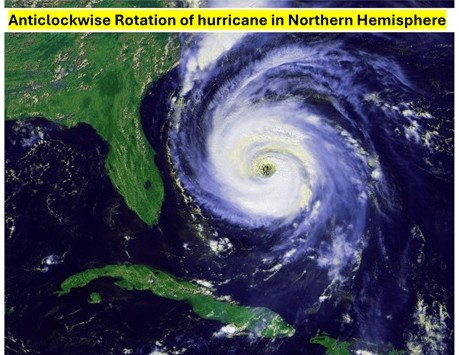
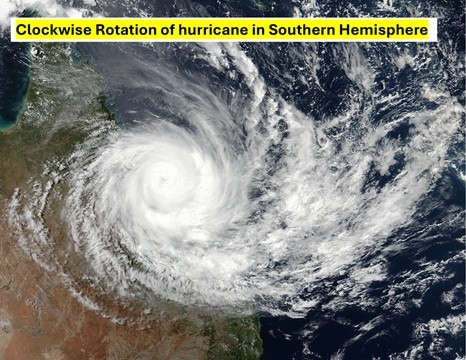
Meteorologists observe the Coriolis effect through the rotation of hurricanes and trade winds. Look at the pictures above closely.
It is interesting to note that the hurricane, in the northern hemisphere, rotates counter-clockwise whereas the one in the southern hemisphere rotates clockwise. This is because of the Coriolis effect.
Conclusion
The Coriolis effect is a fundamental aspect of our planet’s dynamics, shaping the movement of air, water, and even solid objects across vast distances. Its influence is crucial in understanding weather systems, ocean currents, and many other natural phenomena.
By studying and observing the Coriolis effect, scientists and engineers can better predict weather, plan navigation, and appreciate the intricate workings of our rotating world.