Richard Feynman
Discoveries & Legacy
“I think I can safely say that nobody understands quantum mechanics.”
By Richard Feynman
Introduction
Richard Feynman was one of the most influential physicists of the twentieth century. Known for his brilliant mind, playful curiosity, and unusual gift for explanation, he helped reshape modern physics while also becoming one of its most famous public teachers.
He helped people understand difficult ideas in science, and he also became known for helping investigate the Challenger space shuttle disaster. Today, he is remembered for both his scientific work and his clear way of explaining things
Early Life and Education
Born in New York City in 1918, Feynman showed an early talent for mathematics and problem-solving. He studied physics at the Massachusetts Institute of Technology and later earned his doctorate at Princeton University in 1942. Even as a student, he stood out for approaching scientific problems in original ways and for questioning accepted assumptions until he felt he truly understood them.
Major Scientific
Contributions
Feynman made several important discoveries in physics. He helped develop quantum electrodynamics, or QED, which explains how light and matter interact. This research earned him a share of the 1965 Nobel Prize in Physics.
This theory explains how light and electrically charged particles interact. His work helped make the theory much more useful and easier for other scientists to apply. He shared the prize with Julian Schwinger and Sin-Itiro Tomonaga.
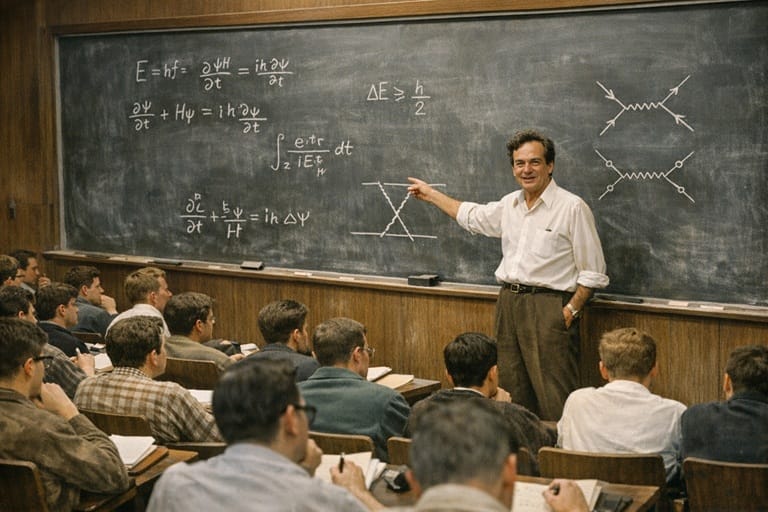
Feynman also developed the path integral approach to quantum mechanics and introduced Feynman diagrams, a visual method that helped physicists represent and calculate particle interactions more clearly. He also did important work on superfluid helium and the structure of protons and neutrons
Feynman’s Legacy
Richard Feynman’s legacy is important in both science and education. He gave scientists new ways to study how tiny particles behave. He also showed that real understanding means being able to explain ideas clearly. Many people respect him not only for his discoveries, but also for his honesty, curiosity, and love of learning. He did not care much about status or fame. Instead, he cared about finding the truth. Feynman was also known for his lively personality, strong curiosity, and love of learning.
Richard Feynman remains a powerful example of what science can look like at its best: creative, disciplined, skeptical, and full of wonder. His achievements in physics changed the field, but his way of thinking inspired people far beyond it. For many readers and students, he continues to represent the joy of asking questions and the value of understanding the world as deeply as possible.
Challenger Investigation
Feynman helped investigate the 1986 NASA’s Challenger disaster. He was a member of the Rogers Commission, which studied why the space shuttle exploded soon after launch. He became famous for a simple demonstration that showed how the rubber O-rings became less flexible in cold weather.
This helped people understand one cause of the disaster. He also warned that serious problems can happen when leaders ignore the concerns of engineers.
Books by Feynman
Feynman wrote or inspired several well-known books. Some of the most famous are The Feynman Lectures on Physics, QED: The Strange Theory of Light and Matter, Surely, You’re Joking, Mr. Feynman! And What Do You Care What Other People Think?
These books helped many readers learn more about physics and about Feynman’s life and ideas.
Conclusion
In conclusion, Richard Feynman was an extraordinary scientist and teacher. He made important discoveries in physics, helped explain science clearly, and showed the value of truth and careful thinking.
Richard Feynman remains a powerful example of what science can look like at its best: creative, disciplined, skeptical, and full of wonder. His achievements in physics changed the field, but his way of thinking inspired people far beyond it. For many readers and students, his work, teaching, and books continue to inspire students and scientists around the world.
References
- “About Richard Feynman: Biography.” The Official Site of Richard Feynman, www.feynman.com/about/biography/.
- “Richard P. Feynman – Facts.” org, Nobel Prize Outreach, www.nobelprize.org/prizes/physics/1965/feynman/facts/.
- Gleick, James. “Richard Feynman”. Encyclopedia Britannica, 7 May. 2026, https://www.britannica.com/biography/Richard-Feynman. Accessed 19 May 2026.