There are several simple experiments you can do at home to demonstrate the phenomenon of surface tension in fluids.
For instance, you may be surprised to learn that a light metal coin or pin can float on water. Using a wire mesh as a cover, you can even keep water inside a glass after flipping it upside down.
Keep reading for more details.
Floating Coin
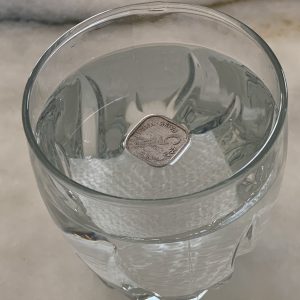
Surface Tension keeps the coin afloat
Take a look at the picture above. Do you know why this aluminum coin is floating? It’s due to surface tension phenomenon occurring because of cohesive forces acting between the water molecules.
If you’re interested in learning more about surface tension, check out this post.
Floating Pin
Watch this video. Isn’t it amazing that a steel pin can float on water if placed gently? Once again, it’s the surface tension of the water that supports the pin and keeps it afloat.
Why Upside-Down bottle
Holds Water
The above video is quite fascinating. You can see that the bottle’s lid consists only of a wire mesh, yet when the bottle is flipped upside down, the water remains inside. This is because surface tension keeps the water from escaping.
Conclusion
Surface tension is a special property of fluids that makes it act like it has a stretchy skin on top. Because of this, light objects like coins or pins can float, and water can stay inside an upside‑down bottle. These fun experiments show that water can do surprising things! Surface tension also helps explain why water drops are round, why soap is required to clean better, and how tiny insects can walk on water.
By trying simple experiments, we can see that science is all around us—even in a glass of water.