AmazingPhysicsForAll

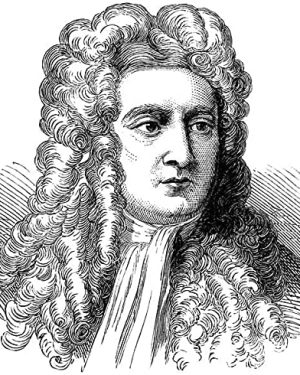
Sir Isaac Newton

Discoveries & Legacy

Isaac Newton
Sir Isaac Newton (1643 -1727)

Nature and Nature’s Laws lay hid in night. 

God said, Let Newton be! And all was light.

Epitaph written by Alexander Pope 

Overview

Sir Isaac Newton stands as one of the most influential figures in the history of science. He was the greatest genius science has ever seen. His discoveries and legacy are unparalleled.


His pioneering work in physics, mathematics, and astronomy shaped our understanding of the universe.


Newton’s discoveries laid the foundation for classical mechanics, introduced new mathematical methods, and established principles that influenced generations of scientists and thinkers.

Major Discoveries

1. Laws of Motion:

Newton’s most renowned contribution to science is his formulation of the three laws of motion. These laws, first published in his groundbreaking work Philosophiæ Naturalis Principia Mathematica in 1687, describe the relationship between a body and the forces acting upon it, and the body’s motion in response to those forces.


The laws are:

  • First Law (Law of Inertia): An object at rest stays at rest, and an object in motion remains in motion unless acted upon by an external force.
  • Second Law (Law of Acceleration): The acceleration of an object is directly proportional to the net force acting on it and inversely proportional to its mass (F = ma).
  • Third Law (Action and Reaction): For every action, there is an equal and opposite reaction.


These laws formed the basis of classical mechanics and are still taught and applied worldwide.

2. Law of Gravitation

Newton’s law of universal gravitation was revolutionary. He proposed that every mass attracts every other mass in the universe with a force that is proportional to the product of their masses and inversely proportional to the square of the distance between them.


This elegant formula not only explained terrestrial phenomena but also accurately described the motion of celestial bodies, such as planets and moons.


For instance, we can compute the attractive force (F) between the earth and the moon by using the following Newton’s universal-gravitation-law’s equation.
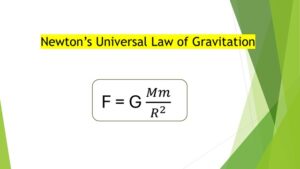


Here F is the attractive force between the earth and the moon due to gravity,

         G is the gravitational constant,

         M is the mass of the earth,

         m is the mass of the moon, and

         R is the distance between the centers of the earth’s and the moon.

3. Calculus

Newton developed a mathematical system to deal with changing quantities, known as calculus (which he referred to as “the method of fluxions”).


While Gottfried Wilhelm Leibniz also independently developed calculus, it was Newton’s contributions that formed the foundation of modern mathematics and allowed scientists to effectively model dynamic systems and processes.

4. Optics

Newton made significant discoveries in optics, demonstrating that white light is composed of a spectrum of colors, which can be separated by a prism as the picture below illustrates.
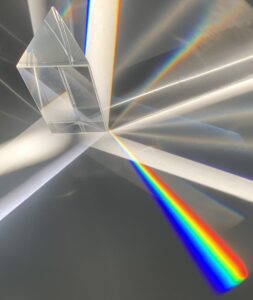
 

Dispersion of sun light  by prism
Dispersion of sun light into colors by prism

Newton was the first scientist to provide a convincing scientific explanation for rainbow. He was able to connect all the three necessary components listed below to give a perfect explanation.

  • The viewer, looking in the right direction – the sun on one side, behind the viewer.
  • The presence of millions of water droplets in the atmosphere on the other side – in front of the viewer.
  • Water droplets’ ability to refract and reflect light.


His experiments with light and color disproved previous theories and led to a new understanding of the nature of light. Ancient Greek philosophers believed that objects produced light, and it travelled to our eyes as rays. Lucretius (99 – 55 BC) thought that light consisted of particles.


The most significant development of particle theory of light was by Newton who called the light particles corpuscles. According to him, light consist of stream of particles (corpuscles), and all illuminous objects produce corpuscles, and they spread out in all directions. Though Newton’s corpuscular theory could successfully explain some of the light phenomena such as reflection, dispersion, and (partially) refraction, it failed to explain the diffraction phenomenon that occurs when light passes through a very narrow slit.


He also invented the reflecting telescope, which improved astronomical observations by eliminating chromatic aberration seen in refracting telescopes.

Newton’s Gravity

Vs

Einstein’s Relativity

Though Newton’s law of gravity could explain (and predict accurately) the orbit of every planet in the solar system, it could not fully explain the anomalous precession of Mercury.


Planets orbit the Sun pivoted to the perihelion point (the point closest to the Sun) , and that point keeps moving ahead from one orbit to the next. This is known as precession of perihelion. Though this precession of perihelion is tiny for other planets, it is quite significant for Mercury.


In the 19th century, astronomers discovered that the actual precession of Mercury is more than what they had computed using Newton’s law of gravity. It differed by about 43 arc seconds per century. One arc second is one-3600th of one degree angle.


This difference remained a mystery until Einstein discovered the new theory of gravity.


Albert Einstein, in the year 1915, published his new theory of gravity which is also known as the ‘general theory of relativity’. Using his newly discovered gravitational theory, he was able to explain and predict Mercury’s precession accurately. The precession predicted by the general theory of relativity matched up with the actual precession.


That was one of the great validations for Einstein’s general theory of relativity. 

Newton’s Space and Time

Vs

Einstein’s Spacetime

According to Newton, space and time are absolute. They are universal, and they exist independent of matter and energy. Space is a fixed backdrop. Time is universal. A common universal clock exists.


However, according to Einstein’s Special Theory of Relativity, space and time are NOT absolute. They are relative to the motion of the observer. But spacetime is invariant. Spacetime is an integral part of matter. It does not exist in the absence of matter or energy.

The Legacy of Newton

Newton’s contributions have had far-reaching effects across multiple disciplines. His laws of motion and gravity became the foundation upon which later scientists built their theories, including Albert Einstein’s theory of relativity. In mathematics, calculus revolutionized the way problems involving change and motion could be addressed.


Beyond his scientific achievements, Newton’s approach to experimentation and reliance on empirical evidence established new standards for scientific inquiry. His insistence on mathematical rigor and logical reasoning shaped the modern scientific method and inspired countless researchers.


Newton also served as the President of the Royal Society and held the position of Master of the Mint, where he reformed England’s currency system. His influence extended beyond science into economics and public service.

Conclusion

Sir Isaac Newton’s discoveries continue to impact our world centuries after his death. He transformed our understanding of nature, established the laws that govern motion and gravity, and created mathematical tools that are vital to science and engineering.


His Legacy endures not only in scientific principles and education, but also in the spirit of inquiry and curiosity that drives progress. Newton’s genius reminds us that the pursuit of knowledge can unlock the secrets of the universe and shape the future of humanity.

References

  1. The Editors of Encyclopaedia Britannica. “Sir Isaac Newton summary”. Encyclopedia Britannica, 29 Apr. 2021, https://www.britannica.com/summary/Isaac-Newton. Accessed 21 October 2025.
  2. A Man Obsessed Isaac Newton; From Great Physicists by William H Cropper, Oxford University Press
  3. Einstein – His life and Universe by Walter Isaacson