
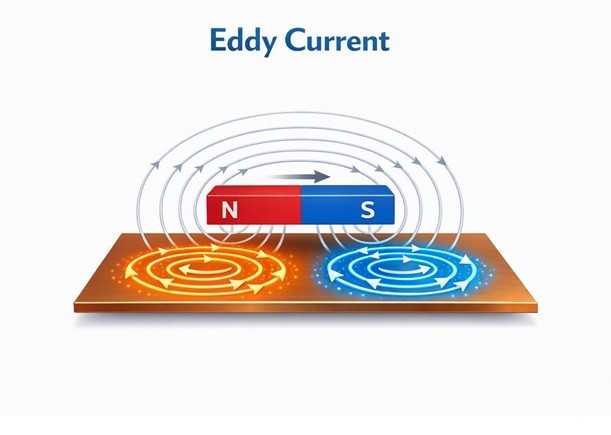
An eddy current is a circular electric current induced inside a conducting material when the magnetic field around or through that material changes. Unlike current in a wire, which travels along a defined path, eddy currents swirl within the body of a metal such as copper, aluminum, or iron.
They are an important effect of electromagnetic induction and are useful in many technologies, although they can also cause unwanted energy loss as heat energy.
A change in magnetic flux through a conductor causes eddy currents. This change may happen when a magnet moves near a metal, when a metal moves through a magnetic field, or when an alternating current produces a changing magnetic field near a conductor.
According to Faraday’s law of electromagnetic induction, a changing magnetic field produces an induced electromotive force. In a solid conductor, this induced force drives electrons in closed circular paths, forming eddy currents.
The direction of an eddy current follows Lenz’s law: the current produces its own magnetic field that opposes the change that created it.
Eddy currents themselves are not usually visible, but we can observer their effects easily.
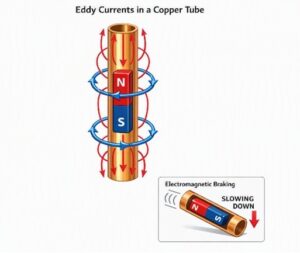
A strong magnet falling through a copper or aluminum tube falls much more slowly than it does through a plastic tube. The falling magnet results in changing magnetic flux. And this change in magnetic flux cause eddy currents, in the copper tube, which resists the magnet’s motion. This opposition produces magnetic braking, heating, or damping effects.
Eddy currents are not just a scientific curiosity—they have practical uses across many industries. Here are some applications:
The effect associated with eddy currents was first observed by François Arago in the early nineteenth century. However, the phenomenon is most strongly associated with the French physicist Léon Foucault, who demonstrated in 1855 that a rotating copper disk placed in a magnetic field became harder to rotate and warmed up because of induced circular currents.
For this reason, eddy currents are also called Foucault currents.
This simple experiment demonstrates that a changing magnetic field can produce eddy currents in a conductor.
Materials needed: A strong cylindrical magnet, a copper tube, and a plastic tube of similar size.
Explanation: As the magnet moves through the metal tube, the magnetic flux through different parts of the tube changes. This induces eddy currents in the tube. The magnetic field produced by these currents opposes the motion of the falling magnet, so the magnet slows down. In the plastic tube, no significant eddy currents are produced because plastic is not a good conductor.
Eddy currents are an important effect of electromagnetic induction. When the magnetic field near a conductor changes, it induces eddy currents that oppose the change that created them.
Although eddy currents can waste energy as heat in machines such as transformers and motors, they are also extremely useful in braking systems, induction heating, metal detection, and material testing. Understanding eddy currents helps explain many practical devices used in science, engineering, and everyday life.