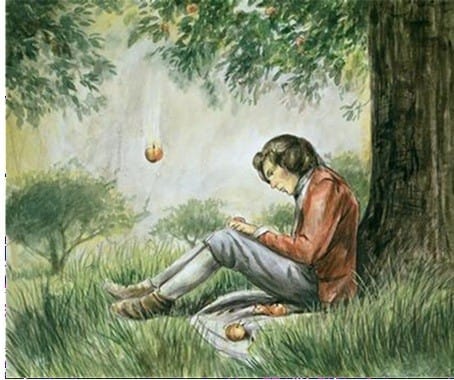
This Photo credit : Unknown author at Creative Common
Falling Objects
Become Weightless
Do you know that falling objects have no weight?
When we see a stone, an apple, or a person fall, it seems obvious that gravity is pulling the object downward. Yet physics reveals a surprising truth: during free fall, the object is weightless. This idea is one of the deepest insights in modern science because it connects everyday experience with the theory of gravity and even helps explain why astronauts float in orbit.
Weight And Free Fall
First of all, what is weight? In ordinary language, weight means how heavy something feels when it presses on a support such as the ground, a chair, or a scale. If you stand on a scale, the scale pushes up on you, and you push down on it. That supporting force is what produces the sensation of weight.
But when an object falls freely, there is no supporting force acting on it. Remember, gravity is still acting, but nothing is resisting the fall. As a result, the object does not feel its own weight. In this sense, a falling object is weightless.
To demonstrate that a falling object is weightless, let us look at two simple experiments.
Falling Water Bottle
With Holes In It
Please watch the video of falling water bottle with holes in it. You may notice that as long as the bottle is held, water keeps spurting out of all the holes. But the moment the bottle is dropped, water stops flowing out of the holes. Why?
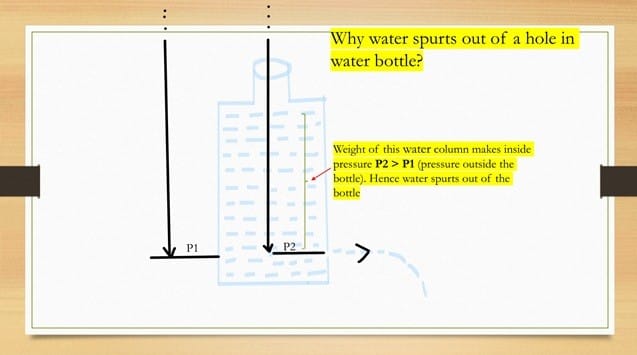
First, we need to understand why water flows out of holes when it is not falling. Please refer to the picture below.
As you can see, the weight of the water column makes the pressure inside the bottle P2 greater than P1 which is just the atmospheric air pressure outside the bottle at that point. Hence water spontaneously starts spurting out of the hole from the high-pressure point inside the bottle to the low-pressure point outside the bottle.
However, when the bottle is dropped the water column inside the bottle becomes weightless. The pressure-gradience reverses: P1 becomes slightly greater than P2. Hence, the greater air pressure outside of the hole holds the water inside. Consequently, the flow of water stops as the bottle falls.
Now let us see what happens to a falling spring balance with a weight hanging from it.
Falling Spring Balance
With a Weight Hanging
Please take look at the video of falling spring balance with 100 grams of weight hanging from it.
You can notice that the spring balance shows 100 when it is held. The moment we drop it the reading springs back to zero. Why? There is no normal force acting on the weight as it falls. Hence it becomes weightless.
Conclusion
These experiments show that a falling object is weightless.
Weightlessness does not mean that gravity has vanished; instead, it means that the support forces that normally make the weight noticeable are absent. This profound idea, sharpened by Einstein into the equivalence principle, transformed our understanding of gravity and remains one of the cornerstones of modern physics.