
Fun With Eddy
Current
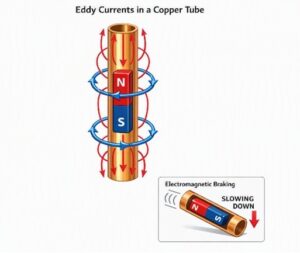
Eddy Current
Let us perform a fun experiment with eddy current.
An eddy current is a circular electric current induced inside a conducting material when the magnetic field around or through that material changes. Unlike current in a wire, which travels along a defined path, eddy currents swirl within the body of a metal such as copper, aluminum, or iron.
They are an important effect of electromagnetic induction and are useful in many technologies, although they can also cause unwanted energy loss as heat energy.
Let us perform a couple of simple experiments to demonstrate the effect of eddy current.
If you would like to read more about eddy current, please read this post on eddy current.
Effect of Eddy Current
Eddy currents themselves are not usually visible, but we can observer their effects easily.
A strong magnet falling through a copper or aluminum tube falls much more slowly than it does through a plastic tube. The falling magnet results in changing magnetic flux. And this change in magnetic flux cause eddy currents, in the copper tube, which resists the magnet’s motion. This opposition produces magnetic braking of the magnet.
Experiment to Demonstrate
Eddy Current
This simple experiment demonstrates that a changing magnetic field can produce eddy currents in a conductor.
Materials needed: A strong cylindrical magnet, a copper tube, and a plastic tube of similar size.
Drop a magnet through a plastic tube:
Take a plastic tube of about 5 feet long. Hold the plastic tube vertically and drop a strong cylindrical magnet through it. Observe that the magnet falls quickly and reaches the ground instantly.
As you can observe in the video, the magnet hardly takes half a second to fall through the plastic tube.
Drop the same magnet through a copper tube:
Now, take a copper tube of about 5 feet long. Hold the copper tube vertically and drop the same magnet through it.
Observe that the magnet falls much more slowly through the copper tube. As you can see in the video, the magnet takes about 5 seconds to fall through the copper tube.
Why does a magnet fall much more slowly through a copper tube? Keep reading.
Explanation
As the magnet moves through the copper tube, the magnet’s magnetic flux through different parts of the tube changes. The changing magnetic flux induces eddy currents in the tube. The magnetic field produced by these eddy currents opposes the motion of the falling magnet. So, the magnet slows down in a copper tube.
Whereas, in the plastic tube, the falling magnet does not induce any significant eddy currents as plastic is not a good conductor. And therefore, the magnet falls normally.
Conclusion
Eddy currents are an important effect of electromagnetic induction. When the magnetic field near a conductor changes, it induces eddy currents which oppose the change that created them.
And this eddy current makes a magnet fall much more slowly in a copper tube as we just demonstrated.
References
- Britannica Editors. “Faraday’s law of induction”. Encyclopedia Britannica, 18 Jun. 2026, https://www.britannica.com/science/Faradays-law-of-induction. Accessed 29 June 2026.
- Britannica Editors. “Léon Foucault”. Encyclopedia Britannica, 7 Feb. 2026, https://www.britannica.com/biography/Leon-Foucault. Accessed 29 June 2026.
- Britannica Editors. “eddy current”. Encyclopedia Britannica, 24 Jun. 2026, https://www.britannica.com/science/eddy-current. Accessed 29 June 2026.
- https://openstax.org/books/university-physics-volume-2/pages/13-5-eddy-currents Authors: Samuel J. Ling, William Moebs, Jeff Sanny